 | |||||||||||||
 | Home | ||||||||||||
| About Brian | ||||||||||||
| |||||||||||||
| Music | ||||||||||||
| |||||||||||||
| Tours & Concerts | ||||||||||||
| Sound Samples | ||||||||||||
| Lectures | ||||||||||||
| Tuition | ||||||||||||
| |||||||||||||
| My Pipes | ||||||||||||
| Links | ||||||||||||
| Search | ||||||||||||
| Contact | ||||||||||||
| Online Store/An Siopa | ||||||||||||
| Music
Cd's Concert Tickets Merchandise E-Books | |||||||||||||

 |  | ||||
For
album reviews of A Piper's Dream by Brian McNamara click
here.
The tempo is exemplary, the performances are crisp and inviting, and the overall feel of the recording is blissfully free of commercial concerns and goals. It's Irish trad music as it was meant to be played, and it's all the more astonishing for the fact that the band, as talented as any in Ireland right now, comprises six people from the same family. That puts the McNamaras in select kith-and-kin company, such as the Lennons (household heads Charlie and Ben both hail from Leitrim) and Galway's Keanes.
Ah, sweet vanity pressing is this, handsomely packaged and well produced, the
best treasure hunt imaginable.
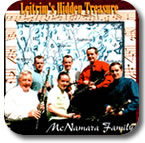
It should be illegal for any family to have so much musical talent as the McNamaras. Michael, the father, and his five children, Brian,Ray, Enda, Deirdre, and Ciarán, are each a past All-Ireland champion, and the album they made together, "Leitrim's Hidden Treasure," is a magnificent tribute to the rich musical tradition of South Leitrim. In the past decade or so, too few recordings have seriously spotlighted this music, the most notable being 1990's "The Missing Reel," featuring South Leitrim flutist John Lee. The McNamaras rectify that oversight with tremendous craft and care, digging into old, newly rediscovered manuscript collections to mine some of the choicest melodies to be heard anywhere in Ireland today. And many appear on record for the first time here. Ably backed by guest guitarist Mick Giblin, the supple, flawlessly paced concertina playing of Deirdre McNamara stands out on the "Miss Dunbarr/Green Fields of America/The Reels of Tully/The Musical Priest" medley, where she's joined by brother Enda on fiddle. The latter is showcased on two tracks, "The Bold Soldier Boy/Logier's/Miss Gunning's Rant" and "Morgan's" hornpipe, accompanied by guest pianist Frank Kelly. Not to be outdone by their siblings, Brian and Ray McNamara perform a breathtaking uilleann pipes duet without accompaniment on "The Unfortunate Rake/The Humours of Ballingarry" jigs. The only track on which their brother Ciarán appears is "O'Connell's Reel/The Mountain Lark/The Cloone Reel/Bernie McKiernan's Dream," and there he does a superb job of matching his father on a wooden-flute duet that soon gives way to a full family affair. The tightness of the playing by all six McNamaras proves that the common bond of family can offer something altogether uncommon and special musically. Another example of this unique blood tie is the musical families of Charlie and Ben Lennon, both of whom come from Leitrim and cut a fiddle duet 17 years ago of "Larry the Beer Drinker" jig, which they learned from Michael McNamara (who learned it, in turn, from the late great Aughavas flutist John Blessing) and which the McNamaras redo here. Over 70 minutes long, the 17 tracks of "Leitrim's Hidden Treasure" are instrumental music played at just theright speed with just the right touches of ornamentation, never wavering in control, always eminently listenable and, on the uptempo tunes, danceable. Like the Sligo-Leitrim quartet Síona, whose recent "Launching the Boat" album is another masterful "vanity" release, Leitrim's McNamara family demonstrate the vitality of Irish traditional music away from more overtly commercial concerns. To extend the metaphor of its title, "Leitrim's
Hidden Treasure" represents a virtual trove of precious musical gems to be
valued for their beauty and rarity. And if this recording receives the wider acclaim
it surely deserves, don't expect that "treasure" to remain "hidden"
much longer.
--Earle Hitchner, Sep 8, 1998. " A Recording to Treasure" Your "On the Fiddle" correspondent returned this week from a holiday in Ireland, carry-on bags bulging with duty-free whiskey and a batch of new CD's. The best of the latter is a Drumlin Records release from the McNamara family of Aughavas in south County Leitrim. Leitrim's Hidden treasure is the title, and a very apt one. The McNamaras have put together seventy gorgeous minutes worth of tunes, almost all drawn from the local repertoire of one of Ireland's least known strongholds of traditional music. Flute player and family patriarch Michael McNamara is joined on the recording by four musical sons - uilleann pipers Brian and Ray, flute player Ciaran, and fiddler Enda , - and by his daughter Deirdre, on the concertina. Pianist Frank Kelly, guitarist Mick Giblin and hammer dulcimer player Barry Carroll provide appropriately tasteful backing. Among those endorsing Leitrim's Hidden treasure in the liner notes are the well-known Aughavas flute player John Lee, traditional music scholar Harry Bradshaw and the fiddle masters Charlie Lennon and Paddy Ryan. Ryan often serves as an adjudicator at the All-Ireland fleadh cheoil. He is not a man to pull his punches and many a competitor has felt the rough edge of his tongue. This time, however, he gives the McNamaras an unqualified rave, one well worth quoting: "What makes this album so special is that it contains pure, honest to God, heartfelt music played for the love of it, without compromise or any concession to silly gimmickry. The lovely, steady, unhurried tempo, the sweetness and warmth of tone and the elegance of the playing are easily and immediately recognisable." Right you are Paddy! The McNamaras are intensely proud their native region and have filled their recording with music straight from heart of the south Leitrim tradition. Generations of fiddlers, uilleann pipers, flute players from Aughavas and surrounding parishes have created a distinctive local style and repertoire, of which the McNamaras must now be counted the chief exponents. Some of their tunes were learned directly from older tradition bearers, including the late flute player John Blessing and fiddlers Pee Fitzpatrick and Bernie McKiernan. Much of the music on Leitrim's Hidden treasure, however was recovered from manuscripts of south Leitrim tunes put together in the late 19th and early 20th centuries by collectors Stephen Grier and Alex Sutherland. Thanks to the McNamaras, these tunes have emerged from the dusty archives and once again found a place in the living tradition. Uilleann piper Brian, a veteran of several Comhaltas concert tours, is probably the best known of the McNamaras, . He plays several sterling solos as well as some rarely heard piping duets with brother Ray . Enda McNamara, is a fabulous fiddler whose technical mastery is evident in such challenging tunes as "Miss Gunning's Reant", which makes use of the upper reaches of the fingerboard, and "Morgan's Hornpipe" in the difficult key of E-flat. All the McNamaras, are highly accomplished players, however, and all get a chance to shine on Leitrim's Hidden treasure,
The McNamaras, recording has no mainstream distributor and will not be found in
your local record store. This is one of the best Irish traditional music recordings
of recent years, however, and well worth the trouble of ordering by phone or mail.
You can get Leitrim's Hidden treasure, from Ossian USA, 118 Beck Road, Loudon,
NH 03301; telephone (603) 783-4383, fax: (603) No Soldier's songs on this disc, just a healthy helping of the distinctive dance tunes of south County Leitrim, one of Ireland's least-known hotbeds of traditional music. Flute player Michael McNamara is joined on this landmark recording by his daughter Deirdre on the concertina and by four musical sons: uilleann pipers Brian and Ray, fluter Ciaran and fiddler Enda. Many of the McNamara's reels, jigs, hornpipes and slowairs were learned from now-departed local musicians, including the late flute player John Blessing and fiddler "Pee" Fitzpatrick. They have a reintroduced may other tunes to the living tradition from manuscript volumes of south Leitrim music put together by 19th-century collectors Alex Sutherland and Stephen Grier. In addition to some gorgeous family music, Leitrim's Hidden Treasure includes copious liner notes on the history of traditional music in Leitrim and on the sources of the tunes themselves. Rarely if ever as a self-produced "vanity" recording risen to such levels of musical accomplishment and scholarly documentation. The McNamara's Leitrim's Hidden Treasure is available from Ossian USA, 118
Beck Rd., Loudon, NH 03301; tel(603) 783-4383; fax (603) 783-9660;e-mail: ossianusa@aol.cm
Don Meade
You can guess that I am not a man who has to buy a lot of CDs these days. In my exalted position, many of the review copies for MT pass through my hands, and I have to admit to grabbing all the northern Italian, Sardinian, and most of the English ones for my own fell purposes. Most of the others I pass on to those with a better claim to them, only pausing to snatch the occasional Irish offering which particularly takes my ear. It was with profound regret that I selflessly did just that with this disc, Leitrim's Hidden Treasure (passing it on to that fine uilleann piper, Tomás Lynch) - but regretted it almost immediately and actually paid good money out of my own pocket for a second copy ... which was then borrowed (long term) by another Irish friend. Having at last retrieved it, I have found that it's one of those records that I impose on even the most casual visitor to the house if the slightest of opportunities presents itself. Cries of "When did you last hear anything like this?" are to be heard almost daily. Since the CD has come to mean so much to me, I though that a second review - from an outsider's perspective - might be appropriate. This is a very unusual record in almost every respect. The music of Leitrim is not terribly well-known out of Ireland (or even within Ireland, to many of the younger generations) and the McNamara Family is not a name on everyone's lips - though it should be. A six-piece family band is also somewhat unusual, and one fronted by two sets of pipes must be as rare as hen's teeth. It would seem that only recent advances in uilleann pipe-making technology have made it possible to get sets of pipes which will stay reliably in-tune for long enough to allow for the possibility of the tight unison and harmony playing displayed here by brothers Brian and Ray . Then there's the record itself - encouraged and supported by the local PP, number 1 on the Drumlin label, with startlingly bright graphics (no Celtic mists here) and with no distribution except Alan O'Leary's Copperplate. Not at all what you'd expect would turn out to be the most enjoyable record of Irish music I've heard since the lovely Johnny O'Leary CD from Craft in 1997. But all this stuff is actually peripheral ... what really counts is the music and how it's played - and both are stunning! The tunes are all local - either unique to the South Leitrim tradition or local variants of nationally known pieces. Many were learned by Michael McNamara from local heroes like John Blessing, Thomas Canning, Jim Rawle, Pee Fitzpatrick, Bernie and Jimmy McKiernan and the Reilly family. The remainder are from the recently re-dicovered manusripts of Stephen Grier (1883) and Alex Sutherland (early 1900s). Readers familiar with Reg Hall's writings will realise that this means they were set down before the Gaelic League began re-inventing Irish musical history in the early part of this century. 'The Gaelic League's proscription
of what it believed was foreign material resulted in a section of the rural repertory
rarely being represented in radio programmes, and certainly not being tolerated
at Gaelic-revival events, while the League's approval of what it believed was
genuinely Irish boosted that section of the repertory. Thus, in music competitions
at feiseanna, for example, the reel, jig and hornpipe were given equal status
and playing time, while tunes for the barndance, schottische and waltz were disallowed,
which was a distortion of the values then current among rural musicians themselves.
The presentation of instrumental music on the feis competition stage and on the
radio took it one step away from its primary rural function as dance music towards
programme music. In particular, the march - with no rural indoor function - entered
the repertory of the ceilidh band for competition, radio and records, and slow-air
performance - a comparative rarity in domestic music-making - became a criterion
for measuring not only a fiddle or flute player's ability but his or her true
feeling for Irish music. New tunes were introduced into rural repertories from
the worlds of ceilidh dance The Gaelic League's influence made some rural music-makers self-conscious about their inherited repertory and made them devalue parts of it in their own esteem. Apart from contributing to a reshaping of repertory, the League, in promoting slow airs and marches, introduced a nationalist dimension to music-making. Under this influence some rural musicians in Ireland began to think of their music as Irish rather than simply as their own music.' Or, from a different source - Proinsias de Roiste in his 'Note on Irish Dancing', Nodlag 1927, in the Roche Collection of Traditional Irish Music wrote: 'It was unfortunate that in the general scheme to recreate an Irish Ireland, the work of preserving or reviving our old national dances should have largely fallen to the lot of those who were but poorly equipped for the task. For the most part they were lacking in insight and a due appreciation of the pure old style, and had, as it appears, but a slender knowledge of the old repertoire .... The musicians were, apparently as slack in tunes as most others proved to have been in dances .... The spectacular and difficult dances for the few were cultivated to the neglect of the simple ones for the many, leaving the social side untouched except to criticise or condemn .... The ballroom dances in vogue at the time were the quadrilles or sets, lancers, valse, polka, schottische or barn dance, two step and mazurka. These were all banned and nothing put in their place but for a couple of long dances. An exception should have been made, one would imagine, in favour of the popular old Sets, if only on account of the fine old tunes with which they were associated, but they were decried amongst the rest.' Moreover, the tunes from the South Leitrim aural tradition are mostly found in styles passed on from a prevous era. To quote the full and interesting booklet notes: 'It is quite remarkable that such a small area managed to retain so much of its unique style in spite of the all-pervading influence of recordings emanating from the US in the 1920s, '30s and '40s ... reels featuring the older type four-bar parts predominate'. So this CD contains music which is generally of an older vintage than what will be familiar to many of today's lovers of Irish music. And while not being an avid espouser of the 'old is best' maxim, I must say that what's on offer here does appeal to me enormously - and did so even before I read the booklet and discovered its pedigree. The reason is simple - while I've never heard most of these tunes before, they sound almost familiar ... it's stuff I can relate to in a way which is rare when listening to the music of another country. I suppose I run the risk of offending some of my Irish friends and readers (again!) if I say that there used to be a strand of common repertoire running through the repertoires of the rural people of all these islands - in the days before we English so effectively lost our music. But it's true, nonetheless - and I can recognise it in the playing of the likes of Johnny O'Leary, numerous concertina and one-row melodeon players from country areas ... and in the music of the McNamara Family . But, at first hearing, it wasn't the repertoire which caught my attention - but the style in which it is played ... and so we come on to perhaps the most unusual aspect of this CD. Track one sounds completely conventional - four reels played fairly fast by the full band in the tight, crisp, modern style I have come to expect of most of the Irish music CDs which land on my doormat. I carried on with my shredded wheat, unmoved. On track 2, and every one of the other 16 remaining tracks, it seems as if the band had somehow been transported back in time three or four generations ... yet managing to take their modern instruments, skills and recording equipment with them! I still hadn't finished my bowl of cereal at the end of the 71 minutes playing-time. I don't quite know how to describe playing which sounds as crisp and clean as anything out of Cork University, yet as if it came off a 1920's 78, somehow simultaneously. Luckily, I don't need to - here's a sound clip from Track 2, the Leitrim Quickstep / Moll Roe from the Grier MS, played by Brian (pipes), Enda (fiddle), Deirdre (concertina), with Mick Giblin on guitar back-up. Track 3 includes a local version of The Shaskeen which makes good use of the twin uilleann pipes (with fine piano back-up from Frank Kelly). The family's tune notes tell us that it's more or less the same tune as the well-known reel - indeed, that it appears as a reel in the Grier MS - "but it plays better as a hornpipe!" This comment seems to speak volumes about the McNamaras'' approach to their music - and I can only agree with them! Jigs, reels and hornpipes predominate, but there's also the slip-jig set mentioned above with The Barony on the front of Leitrim Quickstep / Moll Roe, and a couple of Airs. One is very attractive - Síle Ní Ghadhra, played as an air, a jig and a florid, old-fashioned 'piece'. Call me an old romantic, but this is lovely stuff - Having spent so much of my life knocking around the Cotswolds, it will surprise no one that I'm rather partial to a good hornpipe - and Morgan's is a good one. Supposedly written by Parazotti, it's usually found in the tradition as The Banks, but this four-part version comes from Grier, including the variations. There's only room to let you hear the first 45 seconds or so of the nearly six minute track, but it does give you an idea of how good a fiddler Enda McNamara is. How many other 1990's bands would give over this much time on their first record to one soloist playing so slowly? Not all of the music is slow-paced, but it does keep well away from the break-neck speeds we have become used to hearing. To quote the admirable Charlie Lennon from the booklet, the tempi are such as to "ensure that each piece is given time to breathe freely and express its own characteristics, a welcome change from some of the present day offerings." Here's the concertina and fiddle playing the reel Miss Dunbarr, again from the Grier MS, and apparently unknown elsewhere. I've never been
sure if the CD's title was intended to apply to the McNamara Family or the wonderful
music they play - or both. Both are certainly deserving of the accolade, and we
should all be deeply grateful that these treasures are no longer hidden. My Irish
music record of the year so far - without any doubt. Rod Stradling - 13.8.99
The McNamara family hails from Aughavas in south County Leitrim. Their love of the tunes and playing style of their native place shines through fromalmost every track and there is nothing home made about the quality of the playing. They have a welter of All-Ireland titles to their credit and one of the boys has won the Fiddle of Dooney and it shows. Perhaps the most exciting feature of this production is the uncovering of a great treasure of previously unrecorded tunes. They have dipped into the Grier collection and the Sutherland collection ad Michael, the father, has weighed in with tunes he picked up in a lifetime of playing with old Leitrim musicians. Add to this the sweetness, and lift, cut-and-slur fiddle and staccato pipes of the Leitrim style and you end up with seventeen tracks and a collection of tunes that are compulsive listening. Deirdre,
the only girl and youngest of the family at seventeen, has obviously modelled
her concertina playing on the Leitrim fiddle style, which is sweet and sure with
a wonderful swinging lift to it. As an example of preserving for future generations
a distinct regional style and the tunes that go with it this is a milestone, but
is more than that. It is a hugely enjoyable celebration of the love of a family
for the cultural heritage of their native place and on top of all that a wonderful
listening experience". Jim Kelly - Oct 1998
"In an effort to preserve the wealth and depth of the repertoire and style
of the musical tradition of the home place the McNamaras have just launched a
superb CD, Leitrim's Hidden Treasure, with the proud boast that a good many tunes
recorded have been aurally transmitted and are not written down anywhere. Who
said all the collecting was done!"
Jim Kelly - Sept 1998
The reaction awarded the arrival of Leitrim's Hidden Treasure in Ireland last year was something akin to a second coming. Suddenly out of the blue almost the debut album from Aughavas' McNamara family sent both scribes and trad listeners into realms of ecstasy. The music of South Leitrim is very much an unknown quantity in the traditional repertoire apart from the musicians whose fame has preceded them like John Blessing and the Lennons, Ben and Charlie much of Leitrim's musical shoal is completly unknown terrritory. On reflection that is probably why Leitrim's Hidden Treasure was greeted so ectatically apart from the sterling performances of The McNamaras themselves. Leitrim does have some hidden musical treasures alright and here is a whole album full of them. The McNamara Family from Aughavas are made up of elder statesman and flautist Michael McNamara and his sons uilleann pipers Brian and Ray , Ciaran (flute),and Enda (fiddle), and daughter Deirdre on concertina. Much of their music comes from the Grier and Sutherland Collections as well as local musicians from the Cloone, Mohill and Aughavas areas. Their treatment of the music is strong and unified possessing a unity typically found in a family circle but allowing space for individual stylings and diversity of approach. The Holly Bush features a tightly knit ensemble sound of two uilleann pipers, flute,concertina and fiddle with Mick Giblin's supple guitar and Frank Kelly's rhythmic piano accompaniment driving the family along. Giblin and Kelly along with hammer dulcimer player Barry Carroll are guests whose input adds further to the total sound making a rich and powerfull outcome. The Barony Jig is a sweetly rolling pipes/fiddle/concertina/guitar set and Morgan's offers an elegant fiddle /piano duet. Sile niGahdra and The Bold Soldier Boy are two extended pieces each running over 7 minutes displaying a knack for mixing varying moods and tempos successfully. The McNamara's performances provide plentiful light and shade as well as a powerful group sound. The accompanying booklet for Leitrim's Hidden Treasure is lavishly illustrated with copious explanatory notes and gives a flavour of the locality. This is both a labour of love and a vital musical travelogue documenting the richness of a musical tradition as yet widely undiscovered and it contains music played with stirring heart and full bodied conviction. A definate contender for album of the year don't miss it. The McNamara Family , Drumlin Records,
Aughavas Co. Leitrim,Ireland,
John O'Regan
"In the course of its history, one of the marked features of Irish Traditional music has been the proliferation of regional styles. Since the start of this century however various developments have increasingly conspired to whittle away at these local dialects and nuances. The gradual urbanisation or Irish society, the development of radio and TV and especially, (None perhaps greater than) the availability of recordings of the masters. Since the 1920s when the recordings of the likes of Michael Coleman and Paddy Killoran provided for the first time the chance for musicians to hear tunes and style outside their own local repertoire there has been a creeping homogenisation of Irish music. While the opportunity to enjoy and to learn from the masters is to be welcomed the downside is that a certain homogenisation of the music is bound to occur. One of the most refreshing developments of recent times is the rediscovery of these local styles. Perhaps the most prominent exponents of this trend are the band Altan whose repertoire comes mainly form the Donegal tradition. A welcome addition is the newly released album by the McNamara Family - "Leitrim's Hidden Treasure", led by pater familias Michael on flute the five younger McNamaras play a combination of pipes, whistle, flute, fiddle and concertina. There is a great variety of tunes and settings on this album interspersed with solos and duets. The playing is full of verve but at the same time steady and unhurried. The arrangements are elegant and imaginative but never over elaborate. While there is the sense that the music is as old as the hills - or the drumlins in the case of Leitrim it is presented in a contemporary and readily accessible manner. The album is so consistently excellent it would be hard to pick any one outstanding track. If a gun was put to my head though I think I would choose Morgan's Hornpipe which, I was surprised to learn, is a variant of a piece by the Italian composer Parazotti. Quite how that got into the repertoire of South Leitrim is anybody's guess. One of the wonderful things about this album is the number of tunes recorded for the first time. And given the quality of the tunes on offer I wouldn't think it will be the last. The album should generate a lot of interest in the South Leitrim tradition and in the Grier manuscript which documents so much of it. Cyber-trad types can check out the McNamaras on the web at http://mcnamara.irish-music.net and there e-mail address is mcnamara@irish-music.net A landmark
recording and highly recommended. And clocking in at a generous 71 minutes the
CD is certainly good value.
Frank Flynn - Nov 1998
THE McNAMARA FAMILY
- Leitrim's Hidden Treasure Drumlin
Seriously, this recording is indeed a treasure. Made more as a labour of love than a commercial venture, it comprises seventeen tracks of music associated with Leitrim for various reasons, much of it rarely or never before recorded. The musicianship is generally of the finest quality, and what it occasionally lacks in technical precision it more than makes up for in spirit and soul. The sleeve-notes, if you can call them that, are extremely impressive: a 20-page booklet with maps, photos, notation, and extensive background information on all the tunes. The "note" on track 1 runs to almost 500 words!
So, who are the McNamara's? There are six of them playing on this CD, from 2 generations (although generation gaps are hard to quantify in Leitrim): two uilleann pipers, two flute-players, a fiddler and a concertiniste (the only female), and they are joined by dulcimer player Barry Carroll and a couple of friends on piano and guitar. The family has been in the thick of the Leitrim tradition for generations, picking up tunes from the flute and fiddle players for whom the county is justly famous such as John Blessing, Charlie Lennon and John Lee. In fact, if you want a good idea of the kind of music we're talking about here, the closest previous recording is probably the lovely album by Seamus McGuire and John Lee ("The Missing Reel", CEFCD 146).
I could go on about the unique rapport which comes from family
groups, the virtuosity of the solo tracks, the amazing pipe duets where both players
and instruments are totally in tune with each other (no mean feat), the depth
of emotion in the slower pieces or the freshness of little-known dance tunes such
as "Cut the Sod" and an unusual version of "The Humours of Ballingarry"
... but I won't. Judge for yourselves, because this is an album you should definitely
acquire. Alex Monaghan | |||||
 |



2002-03 Copyright Piper Brian