 | |||||||||||||
 | Home | ||||||||||||
| About Brian | ||||||||||||
| |||||||||||||
| Music | ||||||||||||
| |||||||||||||
| Tours & Concerts | ||||||||||||
| Sound Samples | ||||||||||||
| Lectures | ||||||||||||
| Tuition | ||||||||||||
| |||||||||||||
| My Pipes | ||||||||||||
| Links | ||||||||||||
| Search | ||||||||||||
| Contact | ||||||||||||
| Online Store/An Siopa | ||||||||||||
| Music
Cd's Concert Tickets Merchandise E-Books | |||||||||||||

 |
 | ||||
For album reviews of FORT OF THE JEWELS click
here.
Don Meade, Dec, 2000
The material is very interesting. Certainly there are classics
like Colonel Frazer and The Groves hornpipe, taken at a very deliberate pace,
but there are many other tunes taken form unpublished sources. One collection
is by William Ford of Cork, who died in 1850, and only 87 of the 150 tunes he
collected in Leitrim from piper Hugh O'Beirne were printed. Even more important
is the manuscript collection of more than 1000 tunes by Stephen Grier (1824-1894).
Of these 64 are in Ceol Rince na hÉireann vol. 4, and 20 appeared on the
CD Leitrim's Hidden Treasure on which Brian played. For this solo debut he has
used another seven. By my reckoning, that's at least 923 to be aired! The notes
and production are a model: he's even found out about the Gusty in Gusty's Frolics.
Time was the catch-phrase about the county, referring to soil fertility, was "Leitrim,
God help us!" Now with the likes The Hidden Treasures and what Brian has
shown here, it's going to be "Leitrim, God's blessed us! John Brophy, October 2000
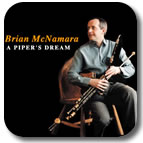
Brian McNamara is a south Leitrim man and proud of it. Born in 1967 in Carrickavoher, Aughavas, Brian was 12 years old when he was introduced to the uilleann pipes, an instrument with a long tradition in the area. The continuity of that tradition was sundered in the early 1900s by emigration and depopulation. Now Brian's mastery of this most Irish of instruments, as heard on his new recording A Piper's Dream, has put south Leitrim piping back on the musical map.
In 1998 Brian produced and played on Leitrim's Hidden Treasure, an acclaimed family
recording that included his flute-playing father and musical siblings in performances
of tunes largely gathered from local sources. A Piper's Dream, which In contrast to the fast-and-furious "open" piping favored by such popular players as Paddy Keenan, Finbar Furey and John McSherry, Brian prefers a less turbo-charged style that is closer to the kind of piping heard in Leitrim long ago. Speed is cheaply impressive, but seasoned listeners will appreciate Brian's perfect intonation, beautiful chordal accompaniment on the "regulators" and deftly fingered staccato triplets. He also gives old-time flavor to many selections by playing low-pitched pipes without the shrillness that often afflicts modern concert-pitch sets. Many tunes on A Piper's Dream were learned from manuscript collections put together in south Leitrim in the 19th century by piper Stephen Grier and fiddlers Thomas Kiernan and Alex Sutherland. Others are classic piping pieces from the repertoire of the late masters Séamus Ennis and Willie Clancy. A Piper's Dream
is not a purely solo effort. Guitarist Jens Kommnick and harp virtuoso Michael
Rooney provide beautiful accompaniment on many tracks. Brian's A Piper's Dream can be ordered for $20, which includes shipping,
payable by check to Brian McNamara, 2 Elm Grove, Summerhill, County Meath, Ireland.
Don Meade
In one way A Piper's Dream is even more of an achievement than Leitrim's Hidden Treasure. To make a wonderful record with a six-piece band is one thing - to present 64 minutes of more-or-less solo playing and retain the listener's interest right to the last note is not a trick many have been able to master ... certainly not at Brian's relatively young age. But he has and he does. The music throughout is a joy to listen to - interesting
and unusual tunes, or versions, played in the unhurried, relaxed style which so
attracted me on the Family I called this 'more-or-less solo' playing because Brian is joined at times by his sister Deirdre on concertina and backed by Michael Rooney on harp and Jens Kommnick on guitar. My preference is for unaccompanied solo performance (as is the case here in 10 of the 17 tracks), but I can find little to quarrel with in the contributions of any of these musicians. Deirdre plays so tightly with her brother that it's often difficult to believe that you're actually hearing two separate instruments, although I'm pleased to see that she does get to lead the set at least once - in the jigs track 8 (sound clip - Stoney Batter), but this may just be that Brian's playing a flat-pitched set, so that the higher-voiced concertina is more obvious. The beautifully produced booklet is full of useful and interesting information, including a four-page account of the South Leitrim piping tradition from the late 18th century to the present day. Although space requires it to be in somewhat condensed form, this and the notes to the tunes - full of references to Brian's sources - are both excellent. I was particularly interested to find out that the English jig I know as the The New May Moon is actually the traditional Irish tune Tom Moore used for his song The Young May Moon and which was (still is) known as The Old Figaree in Leitrim, where it's found in the Grier MS - source of many of the tunes on both McNamara CDs. (sound clip) All in all, a thoroughly excellent CD
- contending for my 'Irish music record of the year'. Rod
Stradling - 30.7.00
Brian McNamara is a Leitrim piper who is well known in sessions around Dublin. He was previously featured on the excellent McNamara family CD "Leitrim's Hidden Treasure". This time he has a recording all to himself, over an hour of exquisite piping from South Leitrim and beyond. The Drumlin tradition of glossy presentation, copious sleeve notes and flawless production is continued with this CD, and from track one it's obvious that the music is once again first class. Brian is a very neat piper, not very flamboyant but precise and measured,
with all the notes in the right place. The tunes here are taken at a reasonable
pace, and the
Brian McNamara - "A Piper's Dream" A tremendous piece of 'concert'
and 'flat piping with attention to detail rarely heard. Superb technique explores
uilleann pipes tone and pitch potential, set with intricate Fintan Vallely - July 23rd 2000 | |||||
 | |||||



2002-03 Copyright Piper Brian